


Li Zexiang, the Chinese professor credited with nurturing some of the country’s most valuable tech start-ups, including DJI, is embarking on a new mission to create multiple Silicon Valleys across China and drive the next wave of innovation.
“For a large country like China, it can’t rely on just one company. It needs communities, and these communities aren’t just limited to Shenzhen or the Greater Bay Area,” Li said in an interview with the Post this month. “It must span multiple cities nationwide, and only then can we see such communities emerge to bring variety and progress.”
Known as China’s start-up “godfather” and “billionaire maker”, Li now dedicates most of his time to promoting his incubation system, which he believes is the key to nurturing the next DJI by building environments that can produce and sustain numerous tech start-ups.
Do you have questions about the biggest topics and trends from around the world? Get the answers with SCMP Knowledge, our new platform of curated content with explainers, FAQs, analyses and infographics brought to you by our award-winning team.
“If there were only one Hewlett-Packard in Silicon Valley, it wouldn’t be the Silicon Valley we know today. Instead, it has witnessed the continuous emergence of generations of tech companies and entrepreneurs,” Li said, adding that tech hubs such as Los Angeles and Boston have also contributed to the US tech landscape.
“We are talking about a country with a population of over a billion people, and true progress can only happen with the support of numerous innovative engines and communities,” he added.

Li Zexiang, a professor at Hong Kong University of Science and Technology, is credited with nurturing some of China’s most valuable tech start-ups, including DJI. Photo: Handout alt=Li Zexiang, a professor at Hong Kong University of Science and Technology, is credited with nurturing some of China’s most valuable tech start-ups, including DJI. Photo: Handout>
Li talked to the Post at the start of January, a day before leading a team of more than 30 start-ups from his XbotPark incubator to Las Vegas to attend CES, the world’s largest consumer technology conference. There he aimed to promote his incubation system and shared factories to the global tech community.
“Many Chinese start-ups usually start from the corners of CES and gradually move towards centre stage,” Li said. “We are trying to expedite the process by bringing them together through Xbotpark.”
Li’s CES trip came amid an increasingly complicated geopolitical environment for Chinese firms, as Washington has continued to tighten chip export controls and recently added more Chinese tech firms to trade blacklists during Joe Biden’s final days as president. President Donald Trump’s return to the White House on Monday has left the tech world clouded in uncertainty.
Against this backdrop, Chinese tech companies face increasing scrutiny as they try to expand abroad. DJI is still battling allegations of Chinese military links, which resulted in US sanctions. Huawei Technologies has become one of the biggest casualties of the tech war as years-long sanctions have restricted its access to American technologies.
“Trade conflicts and geopolitical issues such as tariffs [by the US] eventually hurt its own consumers and consumption market,” Li said.
Despite these challenges, Li said it is still “without a doubt” the right time for Chinese companies to expand overseas. “For Chinese start-ups, it’s just one of the many difficulties that entrepreneurs need to overcome when their companies grow,” he said.
Li himself benefited from the opportunities created by US-China exchanges. Growing up in a rural area of China’s southern Hunan province, Li moved to the US in 1979 for his undergraduate studies at Carnegie Mellon University, then later completed a master’s and PhD at the University of California, Berkeley.
In 1992, Li left the US to join the Hong Kong University of Science and Technology, where he inspired students to turn their school projects into ventures. His best-known protege is Frank Wang Tao, who would go on to start Shenzhen-based DJI, now the largest consumer drone company in the world.
In 2007, a year after the company’s founding, when it had dwindled to just one employee, Li gave a cash-strapped Wang a lifeline by investing in DJI. His students graduating from Harbin Institute of Technology’s Shenzhen campus also provided the company with much-needed manpower.
A decade later, Wang had become Asia’s youngest tech billionaire at the age of 36.

DJI CEO and founder Frank Wang Tao was encouraged to start the drone company by his professor Li Zexiang when he was studying in Hong Kong. Photo: Handout alt=DJI CEO and founder Frank Wang Tao was encouraged to start the drone company by his professor Li Zexiang when he was studying in Hong Kong. Photo: Handout>
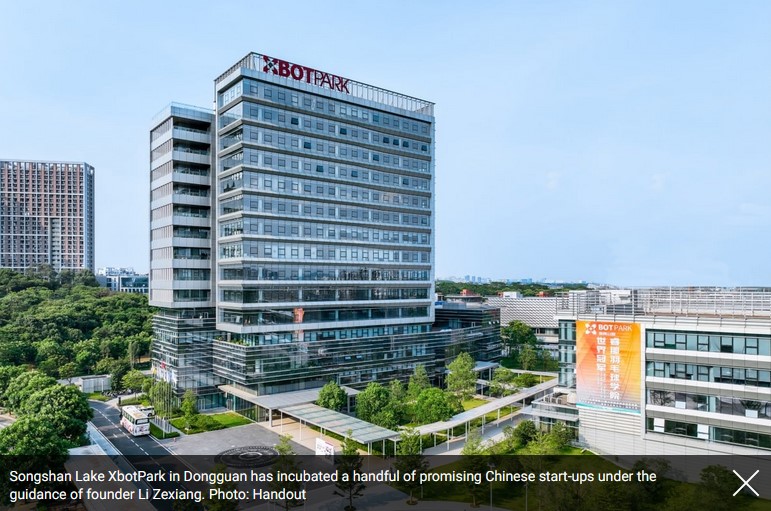
Li has since sought to replicate that success. He co-founded Songshan Lake XbotPark in Dongguan in 2014 to incubate more start-ups in robotics and hard tech, leveraging his investment returns from DJI.
The first team incubated by XbotPark was Narwal Robotics, a smart vacuum maker which is now valued at US$1.4 billion according to data by Crunchbase. Other unicorns from the incubator include logistics robotics firm Hai Robotics, valued at US$2 billion.
XbotPark has expanded to more cities across China, from Hong Kong to Ningbo, and incubated more than 140 companies.
While China’s low-cost manufacturing advantage has been waning amid the rise of new hubs like Vietnam, Li said his innovation system combined with an abundance of engineers would be China’s biggest advantage in global tech competition.
His strategy involves XbotPark incubation platforms working in close collaboration with local universities and governments. In addition to offering funding and training, Li wants to leverage the robust manufacturing prowess of the Greater Bay Area – a scheme that connects Hong Kong, Macau and nine cities in Guangdong province, including Dongguan – by connecting incubated companies to a vast network of established factories that can help build prototypes and first-batch products.
Li’s vision also includes overhauling China’s engineering education at universities to incorporate industrial and supply chain knowledge, better preparing students for entrepreneurship.
“Our base has increasingly attracted city or even district-level [government officials] to visit, eager to replicate the system in their regions,” Li said.
Yahoo News