


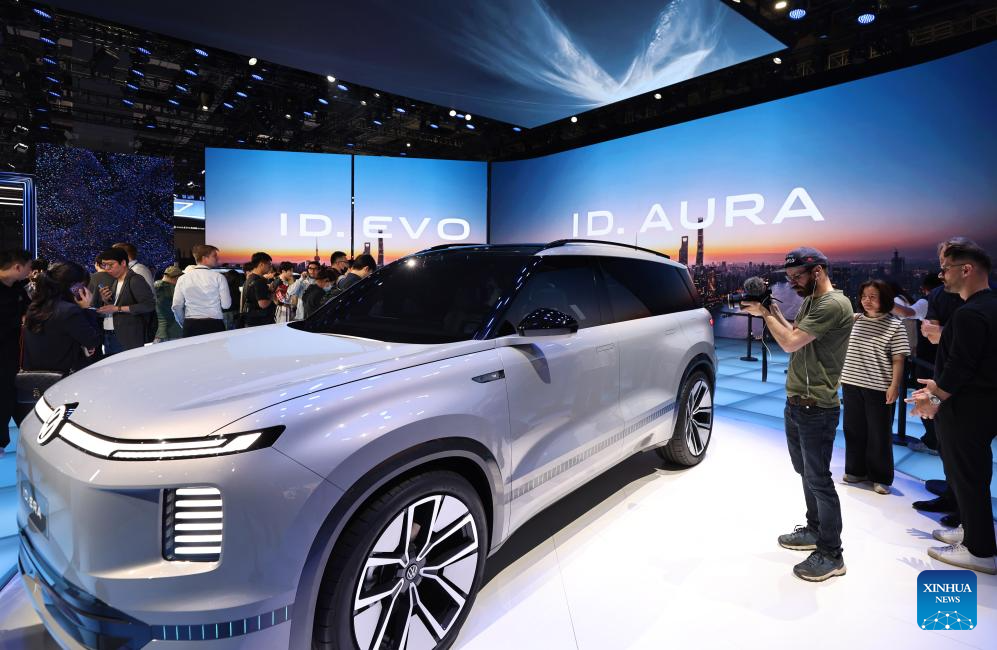
The Auto Shanghai 2025 has emerged as an international event that transcends the traditional concept of an auto show.
Xpeng, Geely, Hongqi…many Chinese car brands showcased not only car models, but also robots and futuristic flying cars at their booths.
The automotive industry in the age of artificial intelligence has evolved into an integrated intelligent industry, comprising low-altitude industries, humanoid robots and embodied intelligence, remarked Zhang Yongwei, vice chairman and secretary-general of NEV industry think tank China EV 100.
If the shift from manufacturing cars to producing machines and even humanoid robots signifies an outward expansion, then the focus on self-research and development to enhance core competitiveness represents the industry’s inward quest.
At the auto show, Chinese electric vehicle maker NIO dedicated a special section to display its core technologies, attracting many foreign exhibitors and merchants. “China has become a global hub for innovation in smart electric vehicles, with companies constantly pushing each other forward,” said William Li, founder and chairman of NIO.
“The driving force behind this is not only our strong market, industrial, and supply chain foundations but, more importantly, the innovative full industry chain that has emerged in China over the past decade. It has enduring vitality,” Li added.
“You have to be here if you want to be an automotive player,” said Stefan Hartung, chairman of the board of management of Robert Bosch GmbH, hailing China’s enormous market scale in the auto industry.
“China has become really from a manufacturing country to an innovation country,” Hartung said, adding that such constant innovation is a “push forward” for the global auto market, which offers “great choices” for consumers.
In Xinhua