


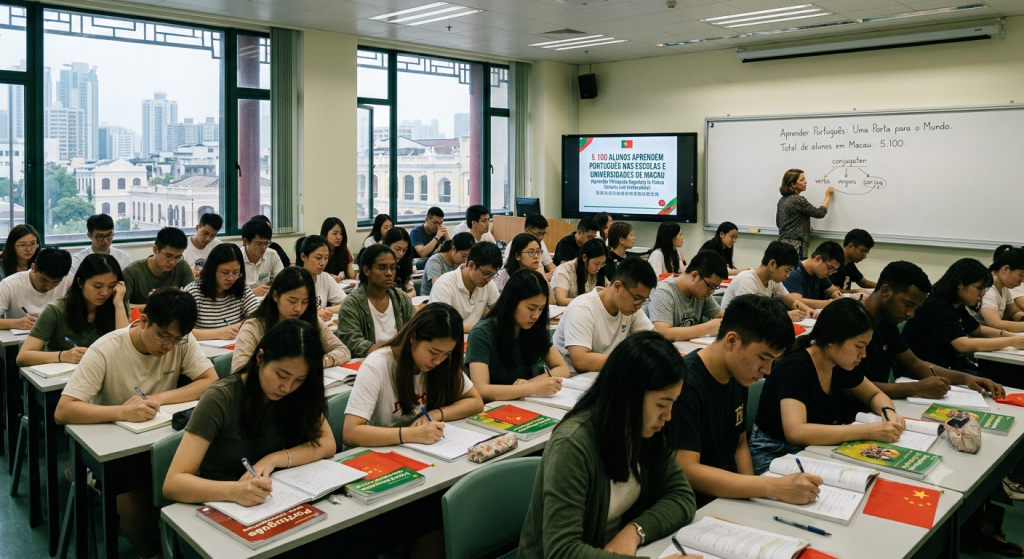
5,100 students learning Portuguese this academic year: over 3,600 in non-tertiary Portuguese-language education – a 20% increase over two school years – while more than 1,500 university students enrolled in courses in or about the Language of Camões, reveals DSEDJ
In the 2025/2026 academic year, 10 public or private schools in Macau provide a Portuguese-language teaching environment to more than 3,600 students. In parallel, at the tertiary level, five institutions offered 19 courses in Portuguese or related to the Language of Camões, with over 1,500 students enrolled, revealed the Directorate of Education and Youth Development (DSEDJ) to the Tribuna de Macau newspaper. According to the Directorate, “the MSAR Government attaches importance to the teaching of the Portuguese language, and is committed to cultivating versatile bilingual professionals in Portuguese aligned with Macau’s development needs.”
Compared to DSEDJ data for the 2023/2024 academic year, the number of schools providing an environment where Portuguese was the medium of instruction rose from eight to ten, and the number of students in that environment registered a 20% increase (from 3,000 to 3,600) over two school years.
At the same time, in the current academic year, more than 110 teachers are registered with DSEDJ as instructors teaching the subject “Portuguese”.
Regarding teaching resources, DSEDJ noted that, in order to enrich them, it developed and published Portuguese-language teaching materials for primary education, based on the Common European Framework of Reference for Languages and the “Requirements for Basic Academic Competencies of the Local School System’s Regular Education” for Portuguese. According to the Directorate, approximately 90% of schools that teach “Portuguese” at primary level refer to and use these materials.
Concerning secondary school teaching materials, the Directorate pointed out that development work – including drafting, composition, design, review and correction – has already begun in an orderly manner. According to DSEDJ, these are being released as pedagogical resources, with the electronic version available on the website of the Centre for the Diffusion of Languages. Some of these materials are already available on the site, with more to be launched.
Additionally, since its launch in the 2023/2024 academic year, the “Portuguese Language Introductory Learning Programme” – a four-year programme comprising phased Portuguese courses, diversified learning activities, cultural experience and language proficiency examinations – has already attracted more than 450 learners/attendances. The course is aimed at local students in the second year of general secondary education or above who are interested in pursuing studies in Portugal or taking Portuguese-related higher education courses, and whose mother tongue is not Portuguese.
Non-tertiary students may also participate in the “Summer Language and Culture Study Trip – Study Programme in Portugal”. Under this initiative, 65 students attended intensive Portuguese courses in Portugal over the last two years, DSEDJ indicates.
From a broader perspective, the body led by Kong Chi Meng emphasises that, in the sphere of non-tertiary education, the MSAR Government “is committed, through systematic training, to cultivating from an early age the listening, speaking, reading and writing skills in Portuguese of students in need or interested” in this area, with schools responsible for promoting the Portuguese language through the regular curriculum, extracurricular or complementary activities.
In a context where the Central Government has assigned Macau the positioning of a Sino-Lusophone Platform and the role of a “precise interlocutor” between China and Portuguese-speaking countries, DSEDJ has previously mentioned the goal of “actively building the Base for Training Qualified Bilingual Professionals in Chinese and Portuguese”.
University education in “stable development”
At the tertiary level, DSEDJ observes that “in recent years, courses related to the Portuguese language have shown stable development.” In 2025/2026, more than 1,500 students are enrolled in 19 courses in Portuguese or related to the language, offered by five institutions – a scenario nearly identical to that of two academic years ago.
In 2014/2015, four universities offered more than ten courses related to the Language of Camões, which at the time had around 700 students.
On the other hand, according to statistics from the “Subsidy for the Purchase of School Materials for Higher Education Students” scheme of the Education Fund, between 2020/2021 and 2024/2025, an average of around 200 students per academic year travelled to Portugal to attend higher education courses.
In this regard, DSEDJ concluded that, with the aim of broadening the channels for Macau students to pursue studies in Portugal, it has in recent years cooperated with various Portuguese higher education institutions, having launched the “Higher Education Programme at the University of Porto for MSAR Students” and the “Study Programme at the Catholic University of Portugal for Macau Students”. Thus, MSAR secondary school students may attend bachelor’s degree or integrated bachelor’s and master’s degree courses at these institutions.
In April this year, DSEDJ signed a co-operation agreement on the pursuit of studies with the Portuguese Institute of the Orient and the University of Coimbra, to offer more options for studying in Portugal.
According to DSEDJ, in parallel, the Government has been promoting exchange and co-operation with Portugal in the field of Portuguese-language teaching, supporting public and private higher education institutions in fostering inter-institutional co-operation and developing projects.
Concrete actions, the Directorate exemplifies, include granting financial support to private higher education institutions for the training of qualified bilingual professionals in Chinese and Portuguese and for co-operation in education. In addition, it coordinates local higher education institutions to establish the “Alliance for Training Qualified Bilingual Professionals in Chinese and Portuguese” (comprising the University of Macau, Macau Polytechnic University, the University of Science and Technology, the City University of Macau, and the University of Saint Joseph), which addresses co-operation in teaching and scientific research, staff exchange, language diffusion, among other areas, with a view to deepening exchange and co-operation between Chinese and Portuguese higher education institutions.
Furthermore, the body stresses that it has been promoting higher education institutions from both sides to enter into agreements on matters such as the sharing of learning information, pedagogical and academic exchanges, and co-operation on staff mobility. This “provides young students with diversified learning, practice and development opportunities, thereby increasing their competitiveness and overall quality,” the Directorate highlights.
2,800 used the Continuing Education Programme to learn Portuguese
In the field of community education, DSEDJ continues to invest in the Centre for the Diffusion of Languages (CDL) and the Continuing Education and Development Programme (PDAC) as channels through which residents may access opportunities to learn the Language of Camões.
The CDL regularly offers Portuguese courses for residents to learn and master basic Portuguese language and culture. According to DSEDJ, over the past five years, the Centre has held more than 300 courses, with places exceeding 1,600.
Under the PDAC, 33 participating institutions launched Portuguese-language courses between 2021 and 2025, with the number of enrolments reaching nearly 2,800. Focusing on different dimensions, such as “technical training” and “liberal arts”, these activities provide Portuguese-learning courses for residents who possess a certain level of basic knowledge of the language, are employed or interested, DSEDJ describes. In 2014, there were around 10 participating institutions in the PDAC offering this type of course, at which time there were approximately 300 enrolments.
According to the most up-to-date data from the Statistics and Census Service, between 2011 and 2021 – a period in which Macau’s local population increased by 16.63% to 550,374 – the number of residents who mastered Portuguese rose by nearly 20.7% to 14,939. This number represented only 2.71% of all residents in 2021, still slightly higher than the 2.62% recorded in 2011.
In the same timeframe, the number of local inhabitants who have Portuguese as their usual language grew by 3.96% to 3,751. The group of residents who spoke Portuguese in their daily lives corresponded to 0.68% of the total in 2021, down from 0.76% registered in 2011.
Source: Tribuna de Macau
AI Translated