


António Costa considers that “we can live” without Chinese investment. The Secretary General of CCILC says that the difficult dialogue between Beijing and Brussels is an exceptional opportunity and does not see a disinvestment
More than ten billion euros later, the Portuguese government has given the first signs of reversing the trend of strong receptivity to Chinese investment. The “blame” lies with the war in Ukraine, which has brought China closer to Russia at the same speed that it has driven Beijing away from the West.
In a recent interview with Público (conditional access), the prime minister said that “we can live” without Chinese investment, since there is none that “brings about a dramatic change in our situation, as implied, from one day to the next, Europe freeing itself of two thirds of gas supply from Russia.
Earlier, the foreign minister had already said that a potential military support to Russia would be a big mistake and would change the way China relates to Europe and “Portugal, of course, would not fail to be affected by this process.” “We would have to review the meaning of our political and economic relationship with China,” said João Gomes Cravinho.
Statements that gain greater relevance in a week when the Chinese President, Xi Jinping, is making an official visit to Russia to strengthen cooperation between Beijing and Moscow, and it is expected that “important bilateral agreements” will be signed.
António Costa, in the same interview to Público, stressed that “the degree of relationship” that Portugal has “with China has nothing to do with the degree of dependence that Germany, in particular, has placed itself in relation to Russia.
This being a factual statement, it is also true that China is currently the fifth largest investor in Portugal and the largest in the Portuguese capital market. Can Portugal really live without Chinese investment? Does the Portuguese government have room to cool its relations with Beijing? What will be the impact of China’s disinvestment in the country ?
Several European countries have also made cooler statements about economic relations with China, but in practical terms little has changed. Trade between China and Germany reached a new record high in 2022 (300 billion euros), with the world’s second largest economy recording its seventh consecutive year as the German economy’s largest trading partner.
These figures show why the German Chancellor in November paid a visit to Beijing accompanied by a strong business delegation. Olaf Scholz was the target of criticism, in Berlin and Brussels, but he is not the only European leader intending to visit the Chinese capital.
French President Emmanuel Macron already has a trip to Beijing scheduled for early April. Italy’s Prime Minister intends to do the same and has made no secret of her goal of strengthening economic ties with China.
“Historic circumstance” represents “exceptional opportunity” for Portugal
“It is not at all foreseeable that there will be a disinvestment from China, quite the contrary,” says the secretary-general of the Luso-Chinese Chamber of Commerce and Industry (CCILC). In statements to ECO, Bernardo Mendia even sees opportunities in the new geopolitical context that resulted from the war in Ukraine.
“I believe that Beijing’s increasingly difficult dialogue with Brussels opens an exceptional opportunity to increase bilateral dialogue between Beijing and Lisbon, whose historical ties and close political relationship places us as a preferential interlocutor,” said the Secretary-General of the CCILC.
“We are, once again, facing a historical circumstance that may be short-lived, so we must be quick to sensitize the Chinese authorities to a better balance of trade, in exchange for having Portugal as a privileged interlocutor,” points out Bernardo Mendia, urging Portugal to “take advantage of this advantage.
Miguel Farinha, EY partner who leads the Strategy and Transactions area of the consulting firm, does not believe that the Portuguese government intends to reverse the strategy of receptiveness to any kind of investment. “We cannot want Foreign Direct Investment in Portugal, but then choose by the quality of the passport which investment we want to receive and which country should invest or not”.
“Portugal is an open economy, which works in a global market and has for many years been creating bridges and not walls,” so the government should “work to have better conditions to receive more quality investment, which generates more productive capacity to the country and creates a more attractive economy for investors,” says Miguel Farinha to ECO.
China remains fifth largest investor
Data from the Bank of Portugal, for the end of 2022, show that China maintains the status of fifth largest investor in the Portuguese economy, a position it has maintained in recent years.
The stock of Foreign Direct Investment (FDI) from China in Portugal amounted to 11.2 billion euros in December last year, which represents the highest value since (at least) the beginning of 2019, when the Bank of Portugal provides these data identifying the last investor. It represents about 7% of all FDI.
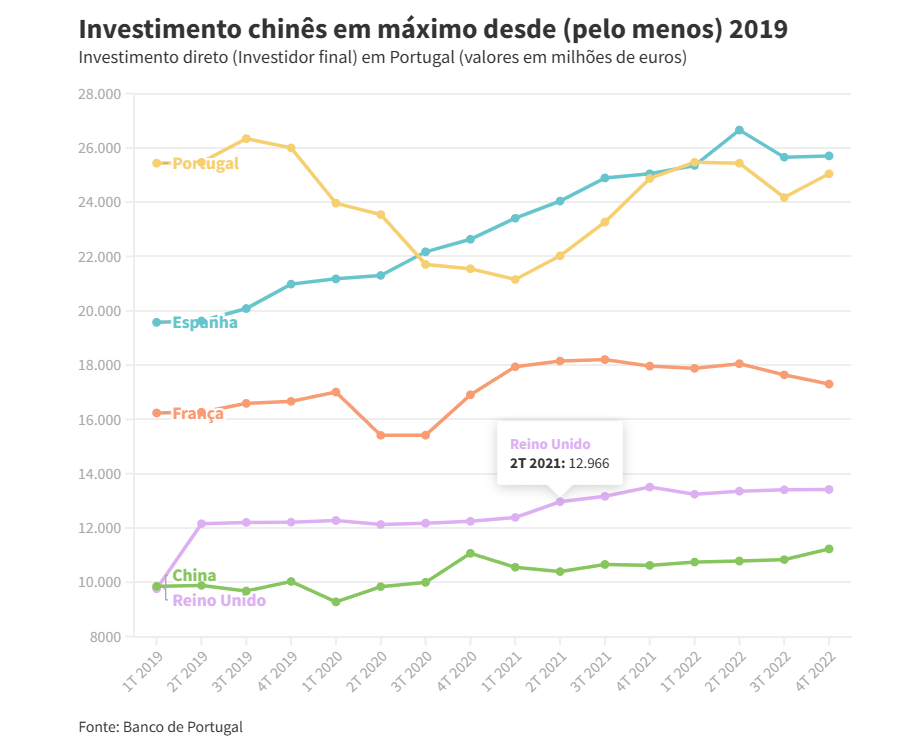
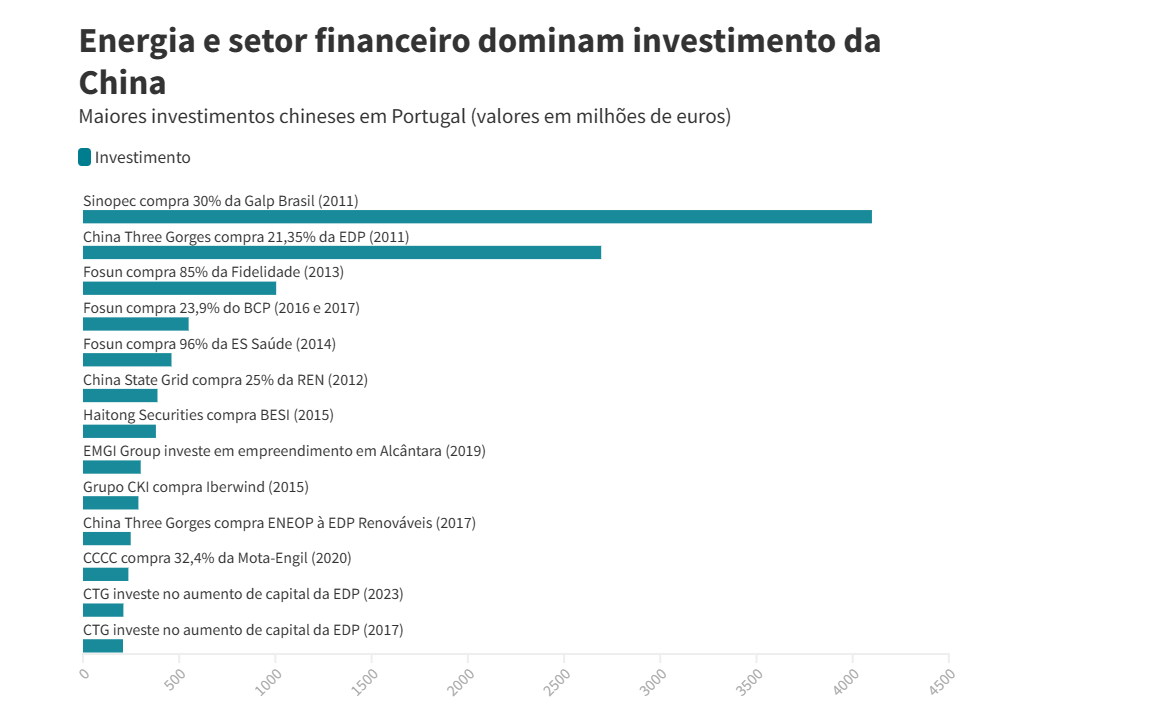
The Chinese investment boom in Portugal happened in the early part of the last decade, with China Three Gorges’ victory in the privatization of EDP opening the way for a wave of asset sales to Chinese public and private companies.
At the time, “one country had an excess of liquidity and policies aimed at investing abroad, while the other had a deficit of liquidity and a need to attract foreign investment,” says Bernardo Mendia, noting that this coincidence of circumstances no longer exists. Still, the secretary-general of CCILC points out that “Chinese investment in Portugal is very important for the Portuguese economy and above all has great potential in terms of greenfield projects.
Miguel Farinha refers that “despite a drop during the beginning of the pandemic,” Chinese investment “has been recovering since the first quarter of 2022,” although it is relevant to divide it into two types.
“If on the one hand, we have the ‘institutional’ investment made in large Portuguese companies which may bring challenges in the future if China supports Russia militarily, on the other hand we have the investment in residential real estate and in investment funds that seek opportunities in real estate,” highlights the EY partner.
Miguel Farinha also warns about the importance of the Chinese economy growing below expectations and Beijing’s focus is now on the domestic market, “rather than continuing foreign direct investment in geographies such as Europe or North America.
Is Chinese divestment a threat?
This strategy of China giving more relevance to the domestic economy, after the global foreign investment boom of the past decade, was evident in the annual session of the National People’s Assembly of China, which ended last week.
However, no signs of China’s intention to disinvest in Portugal are yet evident. CTG invested more than 200 million euros in EDP’s recent capital increase, although it has slightly reduced its dominant position in the Portuguese electricity company.
Last year, China’s Alibaba Cloud announced the opening in Porto of its first service center in Europe. Fosun has several businesses in Portugal (BCP, Fidelidade and Luz Saúde), and the consecutive rumors that it would reduce its presence in the country due to its weaker financial situation never materialized.
According to the operations referenced by CCILC, the accumulated Chinese investment since 2011 is well over ten billion euros, with very few operations that have already been sold. An analysis carried out by ECO at the end of last year quantified the value of the positions held by Chinese companies in companies listed on the Portuguese stock exchange at more than eight billion euros.
“Contrary to what many suggested when Chinese capital entered Portuguese companies, Chinese investment in Portugal has shown some resilience even in times of some uncertainty, demonstrating the well-known Chinese preference for long-term planning,” says Miguel Farinha.
Taking into account the geopolitical developments and the Portuguese government’s statements, “we will have to pay attention not only to the future of Chinese investment in Portugal, but also to the investment already made in Portugal, as is the case in the energy and banking sectors and what consequences this could have,” says the EY partner.
“Any disinvestment will always have effects on the economy,” being “impossible to determine the impacts” if they are made according to “potential economic sanctions on China. If it results from “the sale of Portuguese companies in the hands of Chinese investors, I think that would be the market talking and how much the market would be willing to pay for those assets,” says Miguel Farinha.
Stressing that he has not identified “any difficulty in the dialogue between the Portuguese and Chinese authorities,” which he describes as “excellent,” the secretary-general of the CCILC indicates that potential Chinese disinvestment through the sale of stock positions will mainly have collateral effects, “due to the loss of business contacts in the Chinese market and access to financing from Chinese banks, which has been very generous in contributing to the internationalization of large Portuguese companies.
Source: Eco